Fish farm-Feed R&D collaboration aims to ensure future food supply


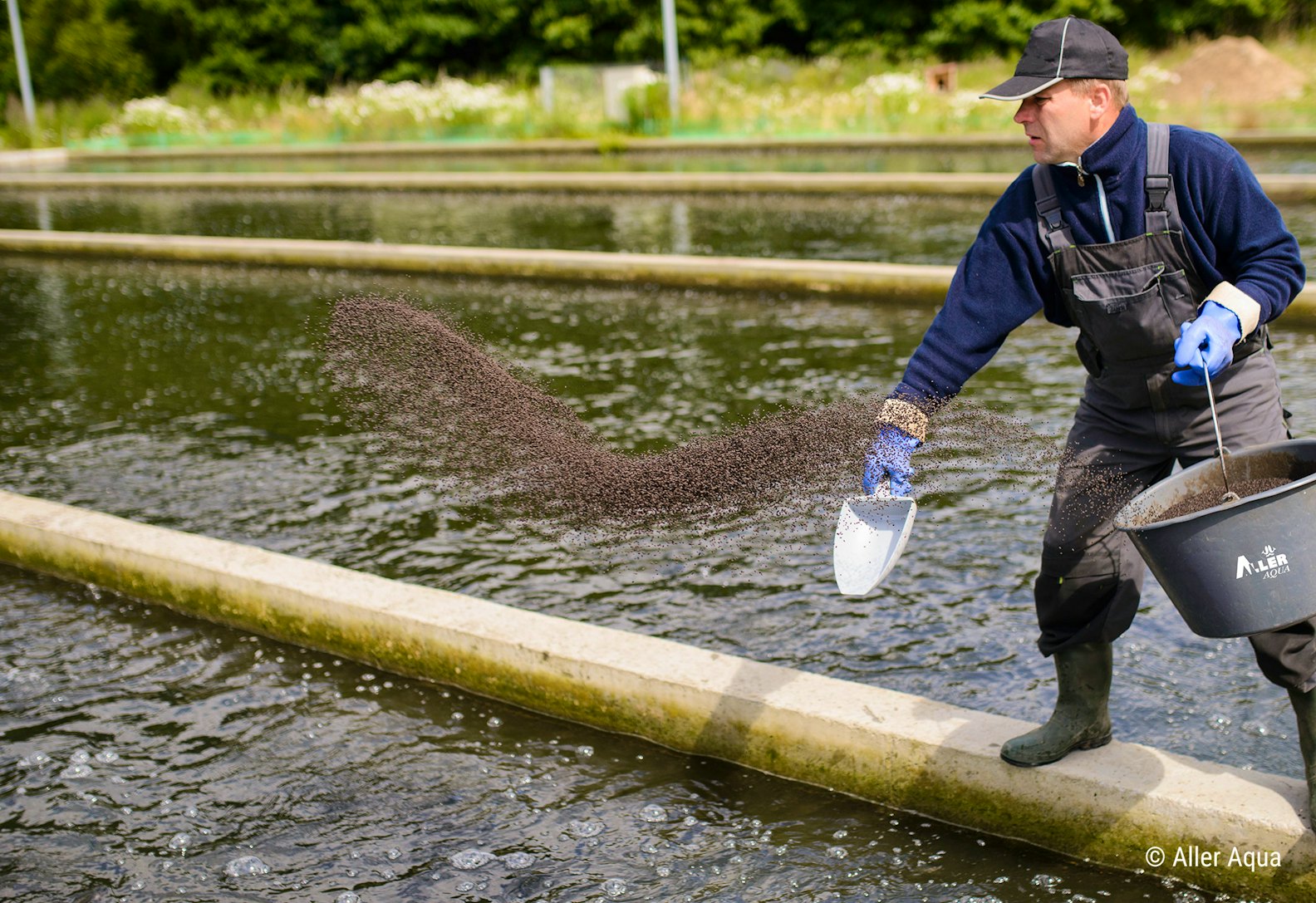
Since 2022, Danish trout producer Danforel and Aller Aqua have collaborated closely, aiming to improve sustainability, efficiency and fish welfare in fish farms. By linking farmers directly with feed R&D, this partnership demonstrates how practical knowledge and data-driven development can deliver measurable results across the aquaculture value chain.
A remarkable collaboration in Denmark has contributed to several improvements in modern fish farming. From better fish health and higher survival rates to cleaner water and reduced environmental impact, the results ultimately support stronger profitability at farm level. According to the two companies, closer integration between feed R&D and production is essential to securing fish as a healthy and reliable food source for future generations.
Accelerating development by sharing insights and knowledge
Danforel operates six fish farms alongside its smoked trout processing facility, supplying supermarkets in Denmark and Germany. For CEO Steffen Nielsen, the newly gained access to extended biological expertise has strengthened operations significantly:
“Through Aller Aqua, we gained access to in-depth theoretical knowledge of fish anatomy and fish welfare. We are the experts in growing and processing fish. But with this stronger biological foundation and deeper background knowledge of the feed and how it affects the fish, we can turn expertise into tangible benefits.”
For Aller Aqua, the knowledge exchange is also central to the partnership. As Ole Schmidt, Sales Director at Aller Aqua, explains, their bimonthly meetings with the farmers provide direct feedback and access to valuable production data:
“Here, we get the farmers’ unfiltered opinion on how our feed performs. This feedback is essential to us. But we also gain access to important data – emission levels, disease occurrence, mortality rates and such. This type of information is confidential in most companies. Here, we are granted access, allowing us to use both insights and data for further development and improvements.”
Offering practical solutions for a growing market
One tangible outcome has been improved phosphorus management. Danforel has developed an entirely new sludge filtration method, while Aller Aqua has formulated feed recipes with lower phosphorus content and properties, causing fish faeces to sink, facilitating a more efficient removal.
According to Steffen Nielsen, this has improved water quality at the fish farms as well as environmental performance at farm level.
“We are required to measure the purity of the water we discharge frequently,” he explains, continuing: “These figures motivate fish farmers to make the water as clean as possible. They live near the farms and are part of the local environment, why they proudly go to great lengths not to pollute or damage nature.”
Focusing on sustainability, efficiency and animal welfare
Both companies are now advancing new initiatives. Danforel has invested in fish oil production to utilise its fish processing by-products more efficiently, while Aller Aqua is researching new feed ingredients, including insect protein and how to utilise some of Danforel’s fish by-products.
All initiatives share the same overall goal – to further improve animal welfare and reduce the environmental impact of fish farming. Looking ahead, Ole Schmidt sees the collaboration as a scalable model for the industry going forward.
“There is a growing focus on sustainability across the EU, and it is gradually spreading globally. Attention to water and water consumption increases, as clean water is becoming a limited resource. We now have the practical experience with technology and feed across different fish production systems here in Denmark. This allows us to offer solutions that work profitably in practice, benefiting all – fish, fish farmers, retailers and consumers alike.”